
By Saree Salter
Updated October 27 2024 – 4:03pm, first published 4:00pm
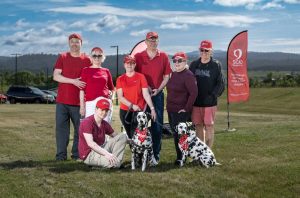
Kieren Clark (in front, then left to right) John Gabel, Shelley Gabel, Steven Clark, Lynne Daniels, Jane Laidlaw, Paul Laidla at the 5km SCADaddle walk. Picture by Phillip Biggs
Shelley Gabel got up to make a breakfast smoothie when she felt like someone “reached in and grabbed her heart”.
The 52-year-old mum of three was in the best shape of her life, but said her arms went numb, and a striking pain shot in between her shoulder blades.
“I turned around to my daughter and said, ‘You need to call mum an ambulance’,” she said.
Mrs Gabel was experiencing a rare condition called spontaneous coronary artery dissection or SCAD, which is the tearing of an inner layer blood vessel – resulting in a blockage that can slow or completely block blood flow to the heart.
The episode can cause numerous heart problems or sudden death.
The SCAD Research Inc revealed the condition was the leading cause of heart attacks in women under 50 and in new mothers, with four to five per cent of cases in women during the end of pregnancy.
Mrs Gabel said doctors told her she wasn’t presenting signs of a heart attack but there was a “little weird thing” on her ECG.
“They tested my troponin levels and that gave the signal that I was having a heart event,” she said.
Mother of two and “gym junkie” Lynne Daniels recalls the day in 2016 when she experienced a SCAD episode.
“It hit out of the blue, my heart stopped and I stopped breathing,” Ms Daniels said.
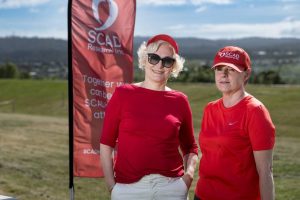
SCAD survivors Shelley Gabel and Lynne Daniels at the SCADaddle walk. Picture by Phillip Biggs
Ms Daniels has since made it her mission to raise awareness and funds for research through SCADaddle.
“When I had my episode there was no research in Australia. Since then we’ve raised over $235,000,” she said.
Funds raised go to the The Victor Chang Institute and reaseach has discovered genes involved in the condition, which Ms Daniels described as “hope”.
Mrs Gabel said she wanted women to trust their instincts and insist that something is wrong when they experience symptoms, even if those symptoms aren’t typical ones.
“Because a lot of medical professionals don’t know about SCAD, they get sent home with a panic attack diagnosis,” she said.
“Ask for a blood test and to have your troponin levels checked – don’t go home too early.”
Ms Daniels said women present different symptoms to men during heart episodes, and in some cases don’t feel chest pain but instead experience symptoms as common as fatigue and nausea.
A SCADaddle walk was held in Launceston on Sunday, October 27.
Ms Daniels and Mrs Gabel said walking along survivors was surreal and healing for them, especially after experiencing health anxiety following their episodes.
“The Facebook groups are great but for me it’s nothing like meeting another survivor in real life,” Mrs Gabel said.
“I was really looking forward to coming along to connect with someone else who knows my experience.”